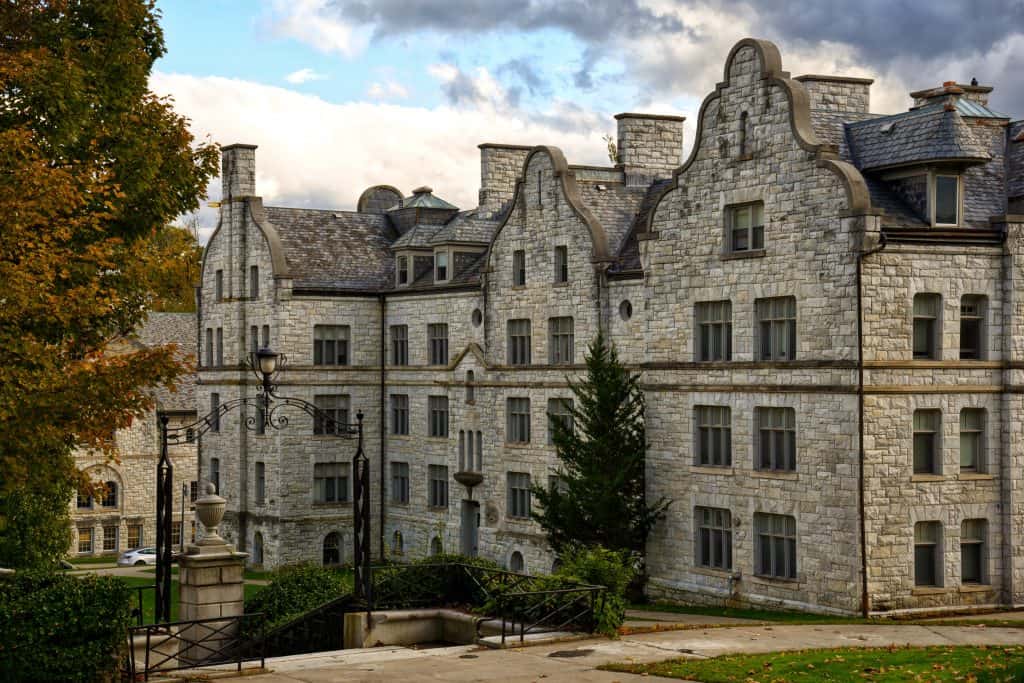
I have been noticing more and more lately the rise of classical style high school and grade school curricula. Sometimes I find out about these because I look at job opportunities with them. When I look at the description of some of the subjects, I find that it is all very similar to the education that I received from Wyoming Catholic College. To a degree, this aggravates me, as if many institutions are trying to jump on the bandwagon of trend in relation to classical curriculum. Yes, I do think that classical curriculum is rich in tradition, but where I become frustrated is that I think that the rest of these institutes are turning Liberal Arts or the sub-category of that, the classics, into a corporate scheme: a means to make money, a gimmick, a cheap stake at trying to be authentic, which makes me think that the education that I received is not very rich anymore, or rather, maybe not as unique because of all of these. Maybe the better way to put it, is that the education that I received was what I believed to be un-conventional, cutting edge, and unique, whereas now, this kind of education has been subsumed or co-opted by societal conventionality.
The question that I want to bring up is conventionality and its relation to paradigm. I think that I disagree with conventionality, at least, at this moment, the conventionality of education. But it may be that I also disagree with the current paradigm. So, I don’t want to discredit conventionality, because I think it is something that keeps things in place and sets a standard, but when convention is in line with a paradigm that is out-of-line, well then, I would have to disagree with it. In that case, I would say that I would agree with un-conventional ways within a given paradigm if it is in line with a potential paradigm that is ordered to truth and goodness, but then this would entail a paradigm shift.
So really, I am just spitballing here… I am frustrated with the conventionality of many things: the work place, careerism, education, dating, basically everything that incorporates societal life or what it means to be a citizen. To that end, what would I propose to all this? That’s tough, but the solution needs to be creative and outside of the box—it needs to be out-of-the-ordinary (is that the correct expression?). It needs to be cutting edge. In regards to education, at a collegiate level, why is it necessary to have doctorate level professors? Could it be Sean or Mary Francis F., or Madison Z., or Josh M., or William E., Nick K., Jack T., or any number of my classmates to teach collegiate level courses? I mean, what it comes down is collaboration and facilitation. And then, does the educational structure even need to be the same? That is, does it need to show certification and proof, or can it just be more of a way of life learning this material as a part of daily life, and in not such a formal manner. Instead, more like a community or network of solidarity? It seems to me that WCC was somewhat of a community of solidarity, although it did not market itself as one. Because, really, it seems to me that a degree is just a form of credential to help one to be received into civil work, which is conventional. I may be putting my foot in my mouth here with this article, but I haven’t done that in a while, so here goes! Oh, and sometimes what I have in mind when I see that conventionality and paradigm do not mix, are those Sci-Fi futuristic movies where people are living in a highly sophisticated technological age, but still dress and act with certain mannerisms of older eras. For example, Firefly, the Matrix, Star Wars, Hunger Games… there are a number of films that represent this.
 Lander's Forge